
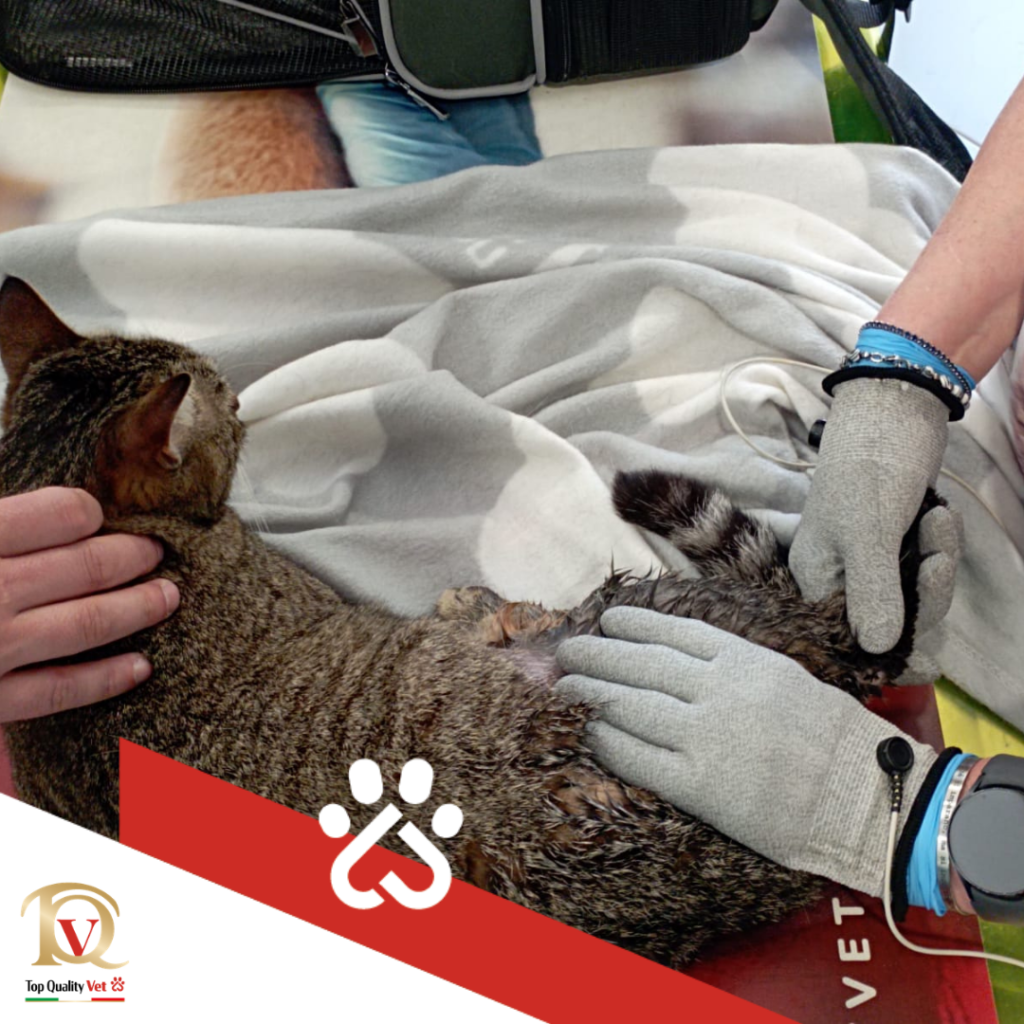
Veterinary neurological rehabilitation can play an important role in patients experiencing motor, proprioceptive, or functional deficits following trauma.
In these cases, veterinary care extends beyond symptom management. Instead it focuses on developing targeted rehabilitation pathways that support the recovery of mobility, sensitivity, and functional ability according to the patient’s specific clinical condition.
The Story of Stella (a two-year-old cat) illustrates how technology can become a valuable tool in supporting veterinary clinical practice, particularly when trauma affects ambulation and hind limb function.
Patient: Stella, a two-year-old female cat.
Clinical history: Trauma caused by entrapment in a tilt-and-turn window.
Clinical findings: Motor and proprioceptive deficits affecting the right hind limb, consistent with suspected ischemic L4–S1 lumbosacral myelopathy.
Technology used: Vet-Therapy platform with electroconductive gloves and veterinary radiofrequency.
Treatment protocol: Electroconductive gloves were used from the first treatment session. Veterinary radiofrequency was introduced from the second session onward, following the patient’s positive initial response.
Clinical outcome: After four treatment sessions, Stella had regained the ability to climb and jump, as reported by her owners.
In May, Stella was found by her owners trapped in a tilt-and-turn window. She was immediately brought to a H24 veterinary hospital, where she underwent a general physical examination, a neurological examination, radiographic imaging, abdominal ultrasonography, and hematological and biochemical testing.
Stella was alert and responsive during the examination, with no evident signs of pain. However, she was unable to walk normally using her hind limbs. The neurological examination revealed an ambulatory flaccid paraparesis with right hind limb platigrade posture and spontaneous dorsiflexion. Postural reactions were reduced in both hind limbs, with a more pronounced deficit on the right side. The withdrawal reflex on the right hind limb was reduced with incomplete hock flexion, while the right patellar reflex was absent. The tail was flaccid, although the nociceptive processing was maintained, perineal reflex and sensitivity remained normal.
The scans revealed no evidence of fractures nor dislocations. The abdominal ultrasound raised suspicion of retroperitoneal edema or contusion, predominantly affecting the right side. Hematological and biochemical analyses also showed a marked elevation in CPK levels, consistent with muscle injury. Based on the clinical history, neurological examination, and diagnostic findings, the overall clinical presentation was considered consistent with suspected ischemic lumbosacral myelopathy (L4–S1), likely associated with reperfusion injury or reduced blood flow.
Window entrapment injuries are well documented in veterinary literature. A retrospective study published in 2024 on the Journal of Feline Medicine and Surgery analyzing 70 cases, highlights how these injuries may compromise blood flow to the spinal cord, muscles, and nerves, potentially resulting in ischemic neuromyelopathy.
The study identifies both the severity and the duration of the entrapment as key factors influencing clinical and neurological outcomes. Parameters such as gait, urinary function, femoral pulse, rectal temperature, and tail function are considered important for patient assessment and prognostic evaluation. Stella’s case, therefore fits within a well-recognized and clinically challenging condition, where timely assessment and the development of a tailored rehabilitation pathway can play a significant role in supporting functional recovery.
After two days of hospitalization, Stella was discharged presenting a significant improvement in ambulatory functions. Despite her overall clinical progress, motor and proprioceptive deficits of the right hind limb persisted, preventing normal weight-bearing during ambulation.
Stella was referred to Dr. Isabella Polverini for further evaluation. The aim was to identify therapeutic options that could support functional recovery of the affected limb while reducing the remaining neurological deficits. At this stage, a veterinary neurological rehabilitation program was developed based on Stella’s clinical response and the functional goals established by the attending veterinarian.
In neurological patients, functional recovery extends beyond restoring movement in an affected limb. It involves improving weight-bearing, proprioceptive control, coordination, sensory function, and the patient’s ability to perform everyday movements effectively.
In Stella’s case, the rehabilitation goal was clear: to support functional recovery of the right hind limb and improve gait function following the ischemic injury.
In this type of rehabilitation pathway, technology can provide valuable support for the vet, particularly when integrated into a comprehensive clinical assessment and a protocol tailored to the needs of each patient.
Vet-Therapy is the Top Quality Vet device designed to support veterinary professionals in building tailored treatment protocols through the use of technologies such as Radiofrequency and Electro-conductive gloves. In Stella’s case, the first part of the treatment protocol entailed the use of the electro-conductive gloves, with the aim of promoting local perfusion and stimulating the nerve endings.
From the second session onward, following the patient’s positive response, Radiofrequency was inserted in the protocol. The technology was delivered on the L4–S1 spinal segments, using a biostimulatory setting.
The aim was to support the reduction of compressive edema, promote local perfusion, and assist functional recovery of the right hind limb. The initial treatment plan included at least six sessions, with a two sessions per week schedule, to support ambulation recovery and reduce the risk of persistent motor deficits.
Stella responded positively to the treatment from the very first sessions. After four sessions, the owners decided to discontinue the rehabilitation, as Stella had regained a level of function consistent with her pre-trauma condition: she was able to climb and jump again.
This result should be interpreted within the context of an individual clinical case, managed by the attending vet and evaluated according to the patient’s initial condition, individual response, and the therapeutic goals of the rehabilitation pathway. It should not be considered a guarantee of outcome, but rather a concrete example of how Vet-Therapy may support veterinary neurological rehabilitation when integrated into a targeted protocol.
Stella’s case highlights the importance of timely and structured intervention in patients presenting post-traumatic neurological deficits. In complex conditions, such as suspected lumbosacral ischemic myelopathy, vets benefit from versatile tools that can be adapted to the patients, their clinical response, and the specific goals of each treatment.
Vet-Therapy provides tools like Radiofrequency and Electroconductive gloves, which can be integrated into tailored protocols; thus providing valuable support throughout functional recovery pathways, local stimulation, and the management of affected tissues. Technology does not replace clinical assessment: it works alongside it. It is precisely through this integration between diagnosis, veterinary expertise, and technological tools that a more comprehensive therapeutic pathway can take shape.
When can veterinary neurological rehabilitation be beneficial?
Veterinary neurological rehabilitation is beneficial for patients experiencing motor, proprioceptive or functional deficits following trauma, neurological pathologies or other conditions affecting mobility.
The aim is to support functional recovery, improve movement quality and develop a therapeutic pathway tailored to the patient’s clinical condition.
What is Vet-Therapy’s role in the treatment protocols?
Vet-Therapy supports veterinarians in developing tailored treatment protocols through the integration of cutting-edge technologies.
In Stella’s case Vet Therapy was integrated as a supportive tool within neurological rehabilitation, with the aim of assisting functional recovery of the right hind limb following trauma.


Copyright © Top Quality Group S.r.l.
Companies Register of Perugia No. / Tax Code / VAT Number 03424560542
REA PG No. 288065
Fill in the fields below to receive the complete technical data sheet of the device directly in your email.
Compila i campi sottostanti per ricevere direttamente nella tua email la scheda tecnica completa del dispositivo.