
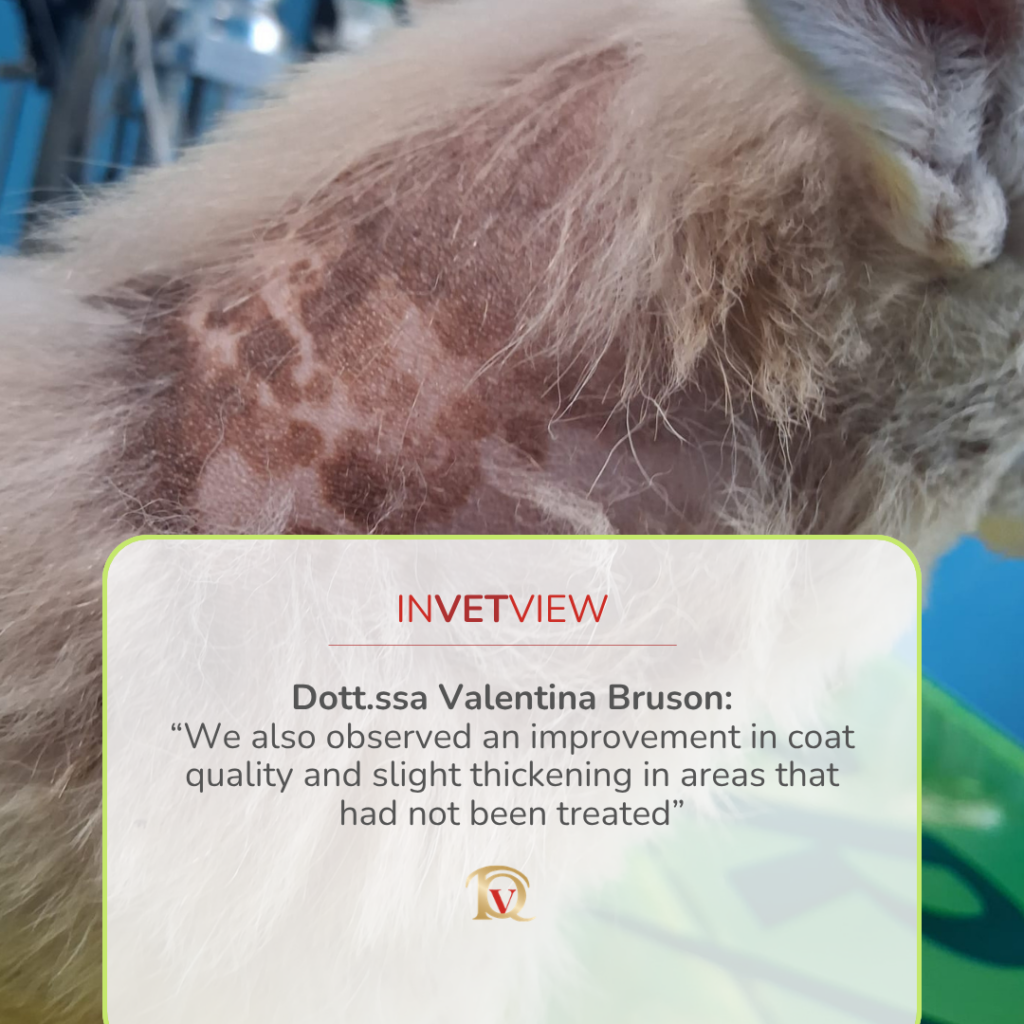
Canine alopecia can have many different causes, making it essential to identify the underlying condition before establishing an appropriate treatment plan. Among its various forms, Alopecia X is a distinctive condition characterized by alterations in the hair follicle cycle and hair loss that can be challenging to manage.
In cases where the loss of fur persists or the regrowth cycle is disrupted, the clinical management can become particularly challenging, often requiring different strategies tailored to each patient’s specific characteristics. We discuss again with Dr. Valentina Bruson, a veterinarian previously featured in our clinical case series for her use of radiofrequency in the management of severe trauma in a turtle.
This case brings a different patient: Perlina, a 10-year-old crossbred between a Pomeranian and a Chihuahua, diagnosed with Alopecia X. Dr. Bruson chose to incorporate radiofrequency into her treatment plan.
We asked her to share The Story of Perlina: her clinical case, the reasoning behind the treatment choice, and the progress observed throughout the treatment.
I graduated in 2006 and, just a few months later, I began working both freelance and at a small animal clinic in the Canavese area (north-western Italy). In the meantime, I also gained experience at Dr. Mattia Bielli’s veterinary practice in Novara, where I learned a great deal about the exotic animals medicine.
In 2010, I finally opened my first veterinary practice, which I expanded in 2015 by adding a well-equipped laboratory, a surgical suite and a small area for outpatient care. We mainly treat exotic pets and wildlife (I also work as an external veterinarian for a wildlife rescue and rehabilitation centre).
Our approach to veterinary medicine is primarily holistic, with particular attention to avoiding the excessive use of medication and treating patients from a Psycho-Neuro-Endocrine-Immunology (P.N.E.I.) perspective.
The patient was Perlina, a 10-year-old crossbred between a Pomeranian and a Chihuahua. She was brought to the clinic in January 2025, shortly after being adopted. Her previous medical history was unknown, and she presented with extensive hair loss affecting the neck, anogenital area, and thighs. Initial diagnostic tests were performed, including a tape strip, skin scraping, and fungal culture.
An oral antiparasitic treatment was also administered to rule out the presence of parasites that were not detectable at the time of examination. Initially, a dermatophyte infection was identified and treated, first with medicated shampoo, followed by oral itraconazole. Given the limited response to treatment, we considered the possibility of immune deficiencies potentially associated with underlying diseases. Therefore, further investigations were carried out, including coprological examinations, hematobiochemical tests, and an abdominal ultrasound.
An alteration in the gut microbiota was identified, as is often the case, which was treated with synbiotics. Moreover, liver enzyme levels were high due to an acute liver condition, which resolved through dietary management in approximately one month. However, Perlina continued to lose fur, with no signs of regrowth. She was therefore referred for a dermatological consultation, which led to the identification of underlying Alopecia X.
Unfortunately, at the moment there is no treatment of proven efficacy for Alopecia X. Several protocols are available, with varying degrees of success. We introduced a homotoxicological drainage protocol with a particular focus on liver support, alongside probiotics, skin supplements containing essential fatty acids, and low-dose melatonin. The loss of fur stopped, but no regrowth of the outer coat was yet observed.
I decided to try radiofrequency to stimulate the fur’s follicular cycle. Beyond the aesthetic aspect, the coat plays an important part in the thermoregulation process, especially in small dog breeds.
I used the transducer in the bipolar, capacitive modality, setting the frequency at 1000 mHz. I set the pulse duration to 250 and the pause to 1000 for a total treatment duration of 10 minutes, in an attempt to obtain a stimulating effect on the hair follicles. The treatment was performed on different skin sections and is still ongoing. The sessions are scheduled weekly for organisational reasons although I suspect that it’s possible to obtain quicker results with a schedule of two sessions per week.
Fur regrowth began after the first month of treatment, initially appearing sparse and irregular, with small tufts and individual hairs emerging. However, the hair shafts were firm and healthy-looking. We also observed an improvement in coat quality and slight thickening in areas that had not been treated. This is probably due, at least in part, to the continuation of the medical therapy.
In Perlina’s case, it was necessary to combine medical therapy, particularly homotoxicological and nutraceutical treatments, with radiofrequency. It is not possible to know at this point whether optimal, complete coat regrowth will be achieved, but this approach is promising. Most importantly, no adverse effects have been observed in this case, which is certainly a positive aspect.
I frequently use radiofrequency to treat dermatological lesions, however I had never tried this approach in a case of alopecia before. Therefore, I believe it is an interesting application that deserves further investigation.
I believe it would be interesting to explore the use of radiofrequency in other cases of alopecia, whether congenital or acquired. For example in cases where patients experience a slower regrowth process.
I was always aware that radiofrequency has many potential applications, and new ones continue to emerge, so this case hasn’t really changed my ideas on the matter. For a colleague who is considering using radiofrequency for the first time, my advice would be simple: give it a try! It is a technology that has a wide range of applications, with virtually no side effects when used appropriately.
Dr. Bruson, thank you once again for sharing your experience with us and for taking us through the clinical reasoning behind this case.
Following our previous discussion involving a turtle, in which we explored the use of radiofrequency in the management of complex trauma, this time you have given us the opportunity to look at the same technology from a completely different perspective: veterinary dermatology.
This versatility, together with the ability to adapt to different clinical needs, is central to the Vet-Therapy philosophy: providing veterinarians with a multipurpose technology that can be easily integrated into everyday practice according to each patient’s needs, therapeutic goals and the protocol selected by the veterinary professional.


Copyright © Top Quality Group S.r.l.
Companies Register of Perugia No. / Tax Code / VAT Number 03424560542
REA PG No. 288065
Fill in the fields below to receive the complete technical data sheet of the device directly in your email.
Compila i campi sottostanti per ricevere direttamente nella tua email la scheda tecnica completa del dispositivo.